Updates - October 17, 2024
Updates
Project management
Data gathering
ElementVape completed
Data cleaning and prep
Starting to look at some data cleaning/prep processes, otherwise no
updates
NLP
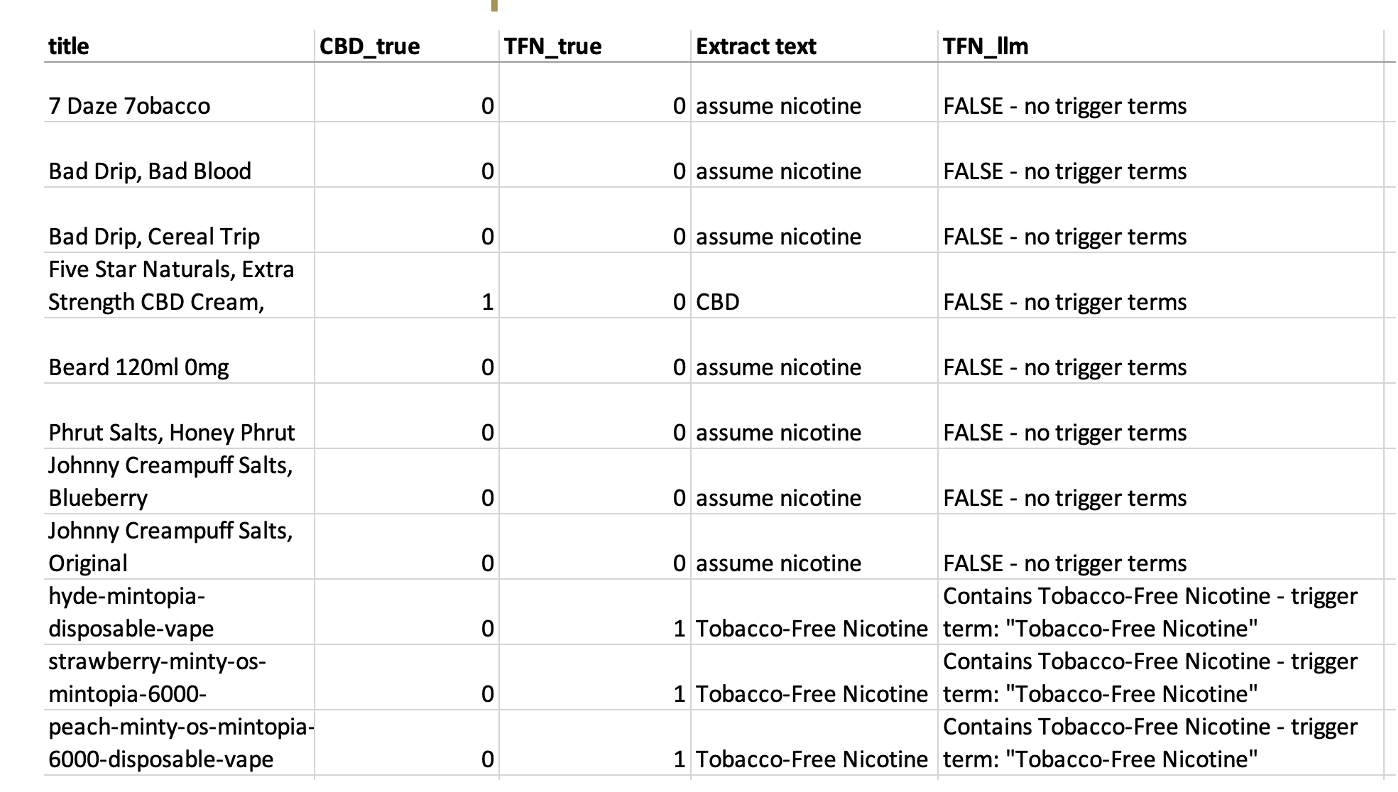
Progress on TFN
Image classification
NLP Updates
Made progress on TFN
TFN/CBD Samples
Computer Vision Model Updates
Working on implementing pre-labeled vape data set to clean our images,
and be able to extract non-vapes.
Labeled and cleaned a decently sized dataset for screens (~9000)
examples from each of the websites. Working on finetuning a model on
this data.
We are making some changes to our processing based on feedback from
CDCF (separating out ICED vs. NON-ICED varieties on same product)
Overall, is a more straightforward classification than screens so
shouldnt be too much of a change
Image Cleaning
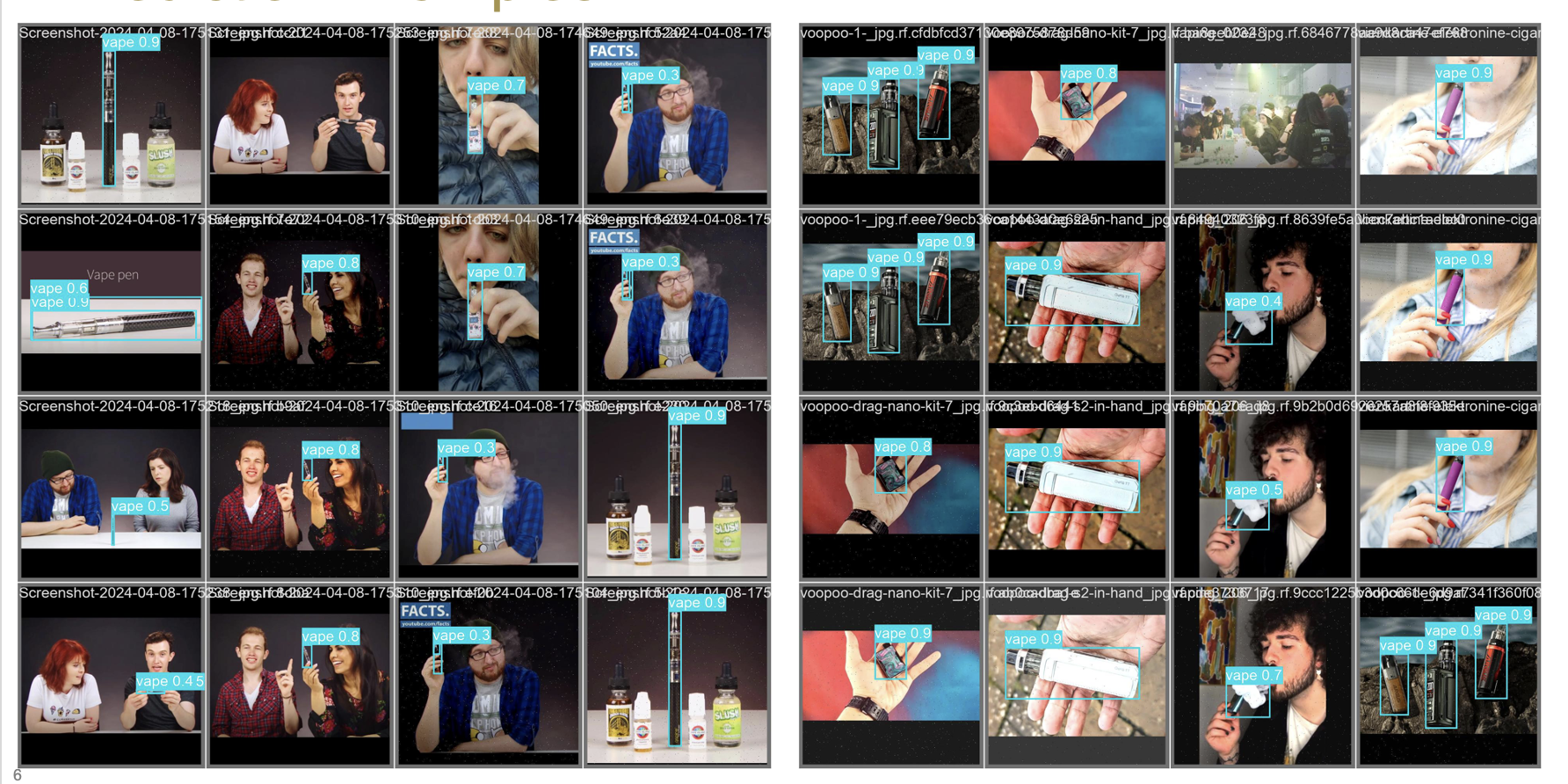
Found a public dataset of vape images with bounding box ground truth,
about 2100 images.
Trained a YOLOv8 model using 80% of the data for training and 20% for
testing.
Preliminary performance without any parameter tuning is about 82%
accurate in detecting vapes in images.
Working on improving this accuracy by increasing augmentation and
potentially adding more data points.
Goal is to use this model to filter through all of the web scraped
images to eliminate those that do not contain vapes as a
pre-processing step for the VLM.
Prediction Examples
Background: Vision-Language Models
Some vape data has a text component, a vision component, or both
E.g: iced flavors, presence of screens, etc.
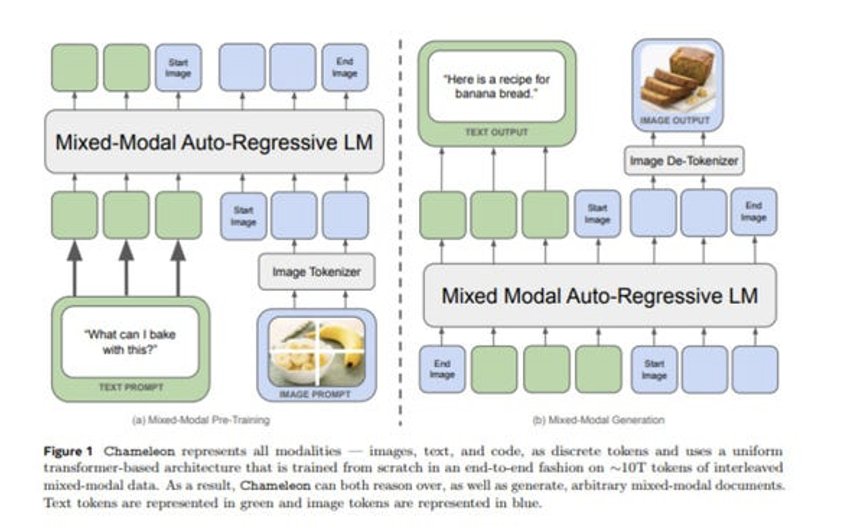
Recent models (e.g: LlaVA, Chameleon) can ingest interleaved text and
images
They consist of an LLM backbone and a vision encoder/tokenizer
VLMs are strong zero-shot learners
Recent VLM research has focused on zero and few shot performance on
various tasks
E.g: Some VLMs can answer questions about images despite never being
trained to do so
Pros: VLMs are very adaptive to novel tasks. We can take advantage of
this to label data
Cons: This can be inefficient, unreliable, and difficult to verify.
Performance highly-dependent on choice of prompt
Our approach:
Design prompts for the variables we are interested in (for now screens
and iced)
Use LlaVA to label a portion of the data (~10,000 examples)
Clean the data for inaccuracies much faster than manual labeling as
LlaVA does a decent job and errors are predictable
Fine-tune another VLM (for now, Flava) on this clean data to achieve
more-reliable performance
Flava is a VLM that can perform both multimodal and unimodal vision/language tasks
Potential options:
We can train the model and use it to label the vape data
We can also deploy the model, allowing CDC groups to query in via an
API without our involvement
Huggingface provides a free inference tool we can develop and share with the CDC