Updates - November 14, 2024
Updates
Project management
Data gathering and prep
NLP updates
CV updates
Data gathering and preparation
Planning to re-run the scraping to get categories/parent links from
the sites
Should be done before next time
Also working on unifying all the data into one model
Previously only done for mipod
NLP Updates
Iteratively improved PRODUCT TYPE classification (72% -> 78%) on
sample test set
Main issues are disposable systems being misidentified–planning to
emphasize “disposable” in future iterations
Flavors
Some sites provide structured flavors, and some do not
Currently working on assessing those and determining best path forward
vape.com: Set up LLM functionality for parsing due to format
variability
vapewh: Set up regex to parse as format is more consistent
NLP Updates SCREEN variable
Initial scan with GPT to determine patterns around screen and displays
Vapewh, vapesourcing, perfect vape, cs vape, vaping.com, vape.com, my
vapor store, getpop
Found several patterns
Display types (LED, LCD, OLED, TFT)
Color/colorful displays
Touch screens
Curved screens
Battery and E-liquid indicators
“Smart” displays
Digital and HD displays
Animated
Backlit and Glow-in-the-dark
NLP Updates SCREEN variable
Should be able to be identified with regular expressions now that we
have the patterns.
Initial regular expressions are built, need to test on larger subset.
Need to isolate which features are most important and/or if any exist.
Examples:
This vape has a colorful touch screen and a battery level indicator.
color_display: [‘colorful’]
touch_screen: [‘touch screen’]
battery_indicator: [‘battery level’]
Features a 3D curved OLED display with e-juice indicators.
display_type: [‘OLED’]
curved_screen: [‘3D curved’]
eliquid_indicator: [‘e-juice’]
High-definition LED smart display screen with animation.
display_type: [‘LED’]
smart_display: [‘smart’]
hd_display: [‘High-definition’]
animated: [‘animation’]
Computer Vision Updates
YOLO Pre-Processing Updates
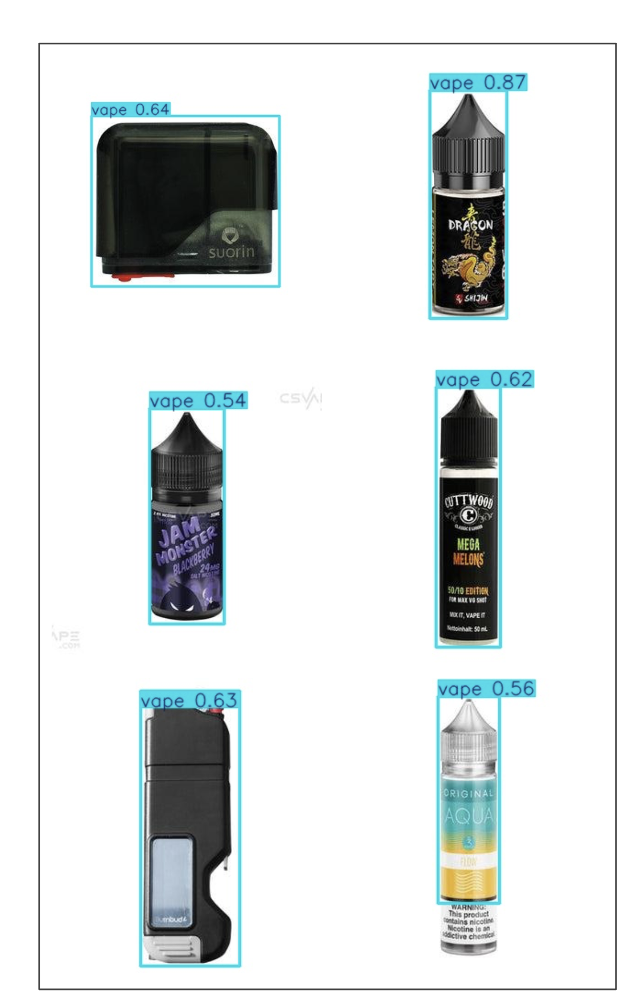
Last meeting we showed the results on the My Vape Store data with and
without tuning on a part of the dataset.
This week we incorporated the entire My Vape Store dataset into the
model to further improve its performance.
To validate its performance, we labeled theCSVape data and used it as
an unseen test set.
This dataset contained 436 total images with 376 of these containing
NO vapes while the remaining 60 contained at least a single vape.
YOLO Pre-Processing Updates Contd
When used for testing the model correctly classified 427 of the 436
images with 8 false negatives (missed vape images) and 7 false
positives (image misclassified as having a vape).
This translates to an image classification accuracy of 97.9%.
For the final model we have added all theCSVape images to the full
dataset and retrained.
This model will be used to classify all images from 9 different
websites that were scraped by the team to identify images with vapes
for use by the VLM.
Deployment Options for CV Models
Model Deployment Background
After training a model, how do we make it useable?
Model deployment the process of exposing the trained model to
end-users for inference
Considerations:
Privacy
Computational resources
Number of requests and latency
Option 1: Push/Pull to/from Huggingface Hub
Pros:
Free! All compute is done locally
Privacy can make model visibility private
Flexibility model can be tuned/changed if necessary
Complexity model requires no management
Cons:
Compute must have access to GPU for reasonable inference speeds
Maintenance must write your own scripts to prepare data and feed to
model
Option 2: Cloud Services (e.g: AWS Sagemaker)
Pros:
Simplicity model can be queried with a simple script like any API
Compute can leverage cloud providers resources
Cons:
Flexibility model is fixed. If changes are needed, must make them
(potentially re-training) and re-deploy
Cost must pay for compute/memory resources
Overkill unnecessary amount of infrastructure for only a small number
of requests
Option 3: Huggingface Inference Endpoints
Pros:
Simplicity of HF + flexibility of cloud
HF manages cloud services as needed only pay for what you use
Built to interface with huggingface models (where our model is built)
Cons
Model still lives in cloud must re-deploy to make changes
Paid (relatively cheap, $0.5 per GPU hour)
What do we recommend:
Inference endpoints are a simpler and more manageable version of
AWS/GCP/Azure
If you want flexibility and are comfortable writing code to run the
model, the first option is likely best
If you prefer a simpler API, inference endpoints are a better option